
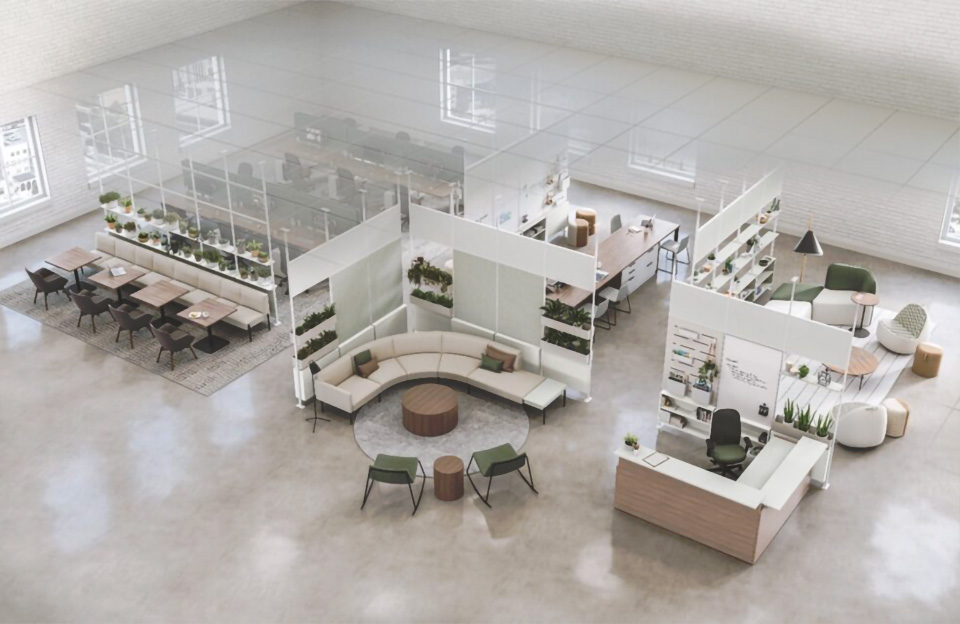
The open office has been declared “dead” countless times, but it’s just evolving.
The chaotic, one-size-fits-all floorplans of the past are being replaced with intentional, flexible environments that balance collaboration, focus, and comfort.
When designed with purpose, open offices remain one of the most effective ways to connect people and drive culture in today’s hybrid world.
From Chaos to Collaboration
Open office design first emerged to promote transparency and teamwork. A 2020 European Parliament report explained that open layouts were meant to reduce real-estate costs, improve collaboration, and enable flexibility (European Parliament, 2020). Over time, however, noise and lack of privacy took their toll. But the problem wasn’t the idea itself — it was the lack of design intention.
Allsteel’s whitepaper, “The Transition from Closed Offices to Open Plan,” puts it simply: “Noise and disruption can undermine the thinking and processing tasks that are a critical part of knowledge work.” (Allsteel Whitepaper)
Today’s open offices fix those shortcomings through purposeful planning, acoustic design, and adaptable furniture systems.
The Modern Open Office: Designed for Choice
1. Activity-Based Working

Modern open offices follow Activity-Based Working (ABW) principles — offering multiple zones for different work modes: focus, collaboration, social, and wellness.
Allsteel’s Idea Starters library shows how furniture systems can create those diverse environments without sacrificing openness or aesthetics. (Allsteel Idea Starters)
“The future workplace isn’t one-size-fits-all,” says Allsteel. “It’s about giving people choice.”
2. Acoustics & Comfort Matter
Noise was the open office’s biggest flaw — but it’s now its biggest design opportunity. Allsteel and Zilenzio, partners in creating healthy acoustic environments, lead this transformation with solutions that absorb sound, define space, and preserve openness.
- Allsteel Recharge Modular Lounge Collection Provides privacy and space definition “without full enclosure,” using soft seating and sound-absorbing materials. (Allsteel Recharge)
- Allsteel Clubhouse Freestanding Structure
Functions as a “room within a room,” enabling focus and small-group collaboration while keeping teams visually connected. (Allsteel Clubhouse) - Zilenzio Cloudz Ceiling Absorbers
Sculptural acoustic clouds that float above open work zones, reducing echo while adding architectural character. (Zilenzio Cloudz)

Together, these systems illustrate how modern design balances acoustics, aesthetics, and human comfort.
A 2024 research review supports this approach, noting that effective open environments “balance collaboration with well-being through acoustic and spatial design.” (ResearchGate, 2024)
3. Built for Hybrid Work
With hybrid work now the norm, the office must earn its purpose. People don’t come in to sit quietly; they come in to connect. Allsteel’s adaptable systems — like the Stride and Mural product lines — support mobility, comfort, and easy reconfiguration. Combined with Zilenzio’s acoustic treatments, these layouts evolve as teams do, maintaining openness while supporting focus.

Why Open Layouts Still Matter
Even with their critics, open offices continue to deliver essential benefits:
- Culture & Connection: Visibility and accessibility build stronger relationships and communities.
- Adaptability & Efficiency: Open zones are easier and less costly to reconfigure than enclosed offices.
- Hybrid Readiness: Designed to flex between collaboration, focus, and digital interaction.
- Brand Experience: Modern, open designs communicate innovation and transparency.
How to Design the Evolved Open Office
Here’s a quick framework for designing an open layout that works, not only for the now but as well as in the future:
- Map Work Modes: Identify how your team’s work: focus, collaborate, socialize, or recharge.
- Layer Privacy: Combine open benches with enclosed options like Clubhouse pods and acoustic screens.
- Use Sound-Absorbing Materials: Ceiling clouds, wall panels, and furniture with integrated absorption (Zilenzio & Allsteel).
- Design for Movement: Choose modular, reconfigurable furniture systems to adapt easily.
- Integrate Tech Seamlessly: Power and video-ready zones help hybrid teams collaborate naturally.
- Reflect Your Culture: Use colors, textures, and materials that embody your brand.
- Iterate: Gather feedback post-occupancy and adjust as needs evolve.
The Future of Work Is Still Open
When done well, openness doesn’t mean chaos, it means connection, adaptability, and belonging.
As Allsteel put it: “The role of place is to support effectiveness — for individuals, teams, and the organization as a whole. When done well, open environments are enablers, not obstacles.”
The open office isn’t dead. It’s evolving, and it’s ready for what’s next.
Ready to Rethink Your Workspace?
At Tri-State Office Furniture, we design open, hybrid-ready workspaces that support how your teams truly work. We help you create a workplace that looks good, feels good, and works beautifully. Contact us today to start your office transformation!
CHAIRS
SIT-TO-STAND
SAFE OFFICE SOLUTIONS
OFFICE FURNITURE & ACCESSORIES
Sources
- Allsteel. The Transition from Closed Offices to Open Plan: Best Practice (allsteeloffice.com)
- Allsteel. Recharge Modular Lounge Collection (allsteeloffice.com)
- Allsteel. Clubhouse Freestanding Structure (allsteeloffice.com)
- Allsteel. Idea Starters – Design Resources (allsteeloffice.com)
- Zilenzio. Cloudz Ceiling Absorber (zilenzio.com)
- Zilenzio. Focus Floor Screens (zilenzio.com)
- Zilenzio. How to Ensure You Always Get the Best Acoustic Solution (zilenzio.com)
- Abirami, D. M. (2024). Open Office Design and its Impact on Employees (ResearchGate)
- European Parliament (2020). Open Plan Offices: The New Ways of Working (europarl.europa.eu)